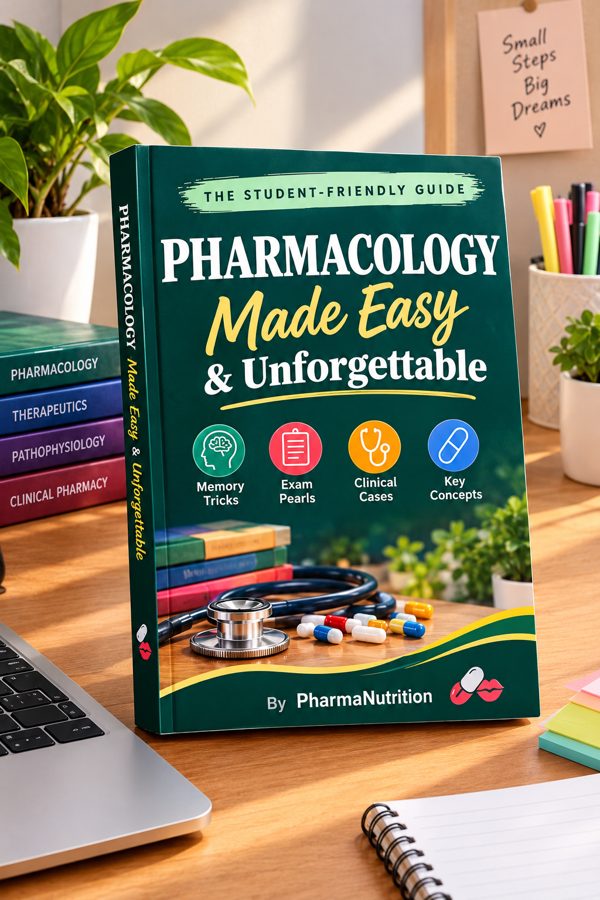
Hundreds of drugs. Names that look alike. Mechanisms that vanish the night after you study them. This guide teaches pharmacology the way a tutor would — in plain language first, then exactly what your exam needs.
You're not the only one feeling this — it's exactly why this guide was written.
Hundreds of drugs, names that look alike, and mechanisms that vanish from your head the night after you study them.
Everyone tells you it's "just memorization" — and that's exactly why it feels so heavy.
Your textbook reads like a list, not a story, so nothing you learn hooks onto anything else.
You need exam-ready pearls, not another 40-page chapter you have to translate yourself.
Learn to ask these yourself and you can figure out almost any drug you meet — in class, on an exam, or on the ward.
What is it?
What class does it belong to?
How does it work?
Why do we use it?
What are the important adverse effects?
What must I remember for exams and real patients?
A real excerpt from Chapter 1 — this is what every drug and drug class in the book looks like.
PK is the Kitchen. The body takes the drug in, chops it up, and throws out the leftovers.
PD is the Dance. The drug meets its partner (the receptor) and together they produce the show (the effect).
Or, in one line: PK = body acts on drug. PD = drug acts on body.
Every page uses the same signals, so you always know what kind of information you're looking at.
A hook, story, or mnemonic that makes a fact stick.
A high-yield point that examiners love to ask.
Something that can harm a patient if you get it wrong.
A close-up look at one important drug.
Where the science meets a real patient.
The chapter squeezed into a few lines for revision.
A few questions to check it stuck — try before you peek.
A dedicated high-yield reference section.
From the rules every drug obeys, to every major body system, to thinking like a clinician.
Language, drug journey through the body, mechanisms, interactions.
Cholinergic and adrenergic drugs and their blockers.
Blood pressure, heart failure, angina, rhythm, clotting.
Asthma, COPD, cough, cold, and allergy.
Antibacterials, antituberculosis, antifungal, antiviral, antiparasitic.
Sedatives, antidepressants, antipsychotics, antiepileptics, opioids, anaesthetics.
Acid, nausea, constipation, diarrhoea.
Diabetes, thyroid, steroids, hormones.
Anaemia and blood clotting.
NSAIDs, gout, autoimmune disease.
Chemotherapy and targeted therapy.
Skin, pregnancy, children, older adults, adverse drug reactions.
You are purchasing a 215-page digital PDF study guide titled "Pharmacology Made Easy & Unforgettable." After checkout you receive a one-time digital download of the PDF file — no physical item is shipped. Read it on your phone, tablet, or computer.
215-page PDF guide, digital download only.
Instant access after checkout, plus an emailed download link.
Students of pharmacy, medicine, nursing, and allied health sciences.
One-time purchase, $29.90. Not a subscription — billed once. Instant PDF download the moment you check out.
Get the Guide — $29.90Secure checkout via Digistore24 · 60-day money-back guarantee
Students of pharmacy, medicine, nursing, and allied health sciences — anyone who needs pharmacology to make sense, not just memorized.
No. It's a study guide to help you understand and remember the material. Always confirm doses, indications, and guidelines against your official prescribing references, your teachers, and your national formulary.
After secure checkout on Digistore24, you'll be redirected to a thank-you page with an instant PDF download. A copy is also emailed to you.
You're covered by a 60-day money-back guarantee via Digistore24. If it's not for you, request a refund — no questions asked.